Three certifications. One question every developer, facility manager, and building owner in South India is asking.
Here is the honest, practical answer — and why your HVAC specification is the single biggest decision in all of them.
There is a moment that happens in every major commercial real estate project in South India now — usually somewhere between design freeze and the first serious tenant conversation — when someone asks the question: which green building rating should we go for?
It used to be an optional question. A nice-to-have, something to be considered if the developer had sustainability ambitions or if a particular tenant requested it. That is no longer the case. Across India's top seven cities, over 65 percent of Grade A office space is now green-certified. In Chennai specifically, 83 percent of the city's total Grade A commercial stock holds a green certification — the highest proportion of any major Indian city. A building without a green rating in this market is not just missing a badge. It is increasingly competing at a disadvantage for the tenants that matter most.
Green-certified buildings command a 12 to 14 percent rental premium on average over non-green buildings. Bengaluru leads with a premium of 23 to 25 percent, with Chennai and Hyderabad following at 13 to 15 percent and 12 to 14 percent respectively. For a developer building a 2 lakh square foot commercial campus on OMR or Outer Ring Road, a 13 percent rent premium on even 70 percent occupancy translates into a number that makes the certification investment look very small in retrospect.
But the question of which certification — that is where the conversation gets genuinely complicated. And that is what this article is about.
The three systems, plainly explained
Before comparing them, it is worth understanding what each one actually is and where it came from — because the origin story of each certification tells you a great deal about its philosophy and its best use case.
Developed by the US Green Building Council, operating in India since 2001. LEED-certified buildings in India have reported 25–30% energy savings and 30–50% water savings. Popular among India's IT sector — major tech parks in Bengaluru, Hyderabad, Pune, and Chennai pursue LEED Gold/Platinum. Four levels: Certified, Silver, Gold, Platinum. Globally recognised — its greatest strength and why it costs more.
Established by CII in 2001, headquartered in Hyderabad. India holds the second-largest green building footprint globally with 19,000+ registered projects covering 15.74B sq. ft. Offers certification tracks for Green Homes, Townships, Factories, Interiors, Healthcare, and metro rail systems. Locally calibrated for Indian climate zones and construction practices.
India's national rating system, jointly developed by TERI and MNRE. Most government-aligned — often mandatory for CPWD/PWD-funded projects. Uses 1–5 star rating across 34 criteria. GRIHA-compliant offices show 30–50% energy reduction and 40–65% water reduction compared to benchmarks.
The market reality in South India — who is asking for what
Before getting into the technical differences, the commercial reality needs to be stated clearly: in South India's premium commercial market, the tenant base has become the primary driver of certification choice, not the developer's preference.
Sustainability is now a top priority for Global Capability Centres in India, increasing demand for green buildings, energy-efficient workspaces, and LEED-certified office spaces. GCCs in India are set for rapid expansion, with projections indicating 2,000+ GCCs by 2026 across Bangalore, Hyderabad, and Chennai. These are Fortune 500 companies, global financial institutions, and technology multinationals — all operating under parent company ESG mandates that specify, by name, the certifications their occupied buildings must carry. Most of those mandates specify LEED. Not IGBC. Not GRIHA. LEED — because their parent organisations in the US, Europe, and Japan recognise LEED.
📊 LEED certification accounts for 74 percent of the share in India's office market as of Q2 2024, with Gold being the most prominent certification level — 49 percent of LEED-certified buildings hold Gold certification.
Embassy REIT, India's largest listed real estate investment trust, became the largest USGBC LEED Platinum v4.1 O+M certified office portfolio in India, while the majority of its Bangalore properties are IGBC Platinum-rated campuses also undergoing USGBC certification assessment. The direction of travel is clear: the most institutionally owned, most enterprise-tenanted commercial real estate in South India is pursuing LEED — and treating IGBC as a complementary, not competing, credential.
Where each certification actually wins
That does not mean LEED is always the right answer. The choice depends critically on who your tenants are, what your budget is, and what kind of building you are creating.
- Building will house GCCs, MNCs, or large tech firms
- Developer brand targets institutional investors or REITs
- Need universally recognised certification
- Pursuing ESG financing or green bonds
Higher cost, but rental premium justifies it for premium enterprise corridors.
- Project serves domestic enterprises or mid-market tenants
- Building residential, township, or mixed-use
- Want faster local approvals & state incentives
- FAR/FSI incentives, tax rebates available
Most practical and cost-effective for mid-market and residential.
- Government facility, educational institution, or public project
- Need alignment with national sustainability policy
- Lifecycle environmental impact is primary criterion
- SVAGRIHA for smaller projects with constrained budgets
The number that makes all three converge: 40 to 50 percent
Here is the fact that connects every green building certification to HVAC — and why it matters specifically to us and to you.
❄️ HVAC systems account for 40 to 50 percent of a commercial building's total energy consumption. 35 percent of the credits in LEED are related to climate change — and energy performance is the single largest contributor. In IGBC, the Energy Efficiency category carries the most points. In GRIHA, green buildings consume 40–60% less electricity than conventional buildings — with HVAC being the largest single lever in that reduction.
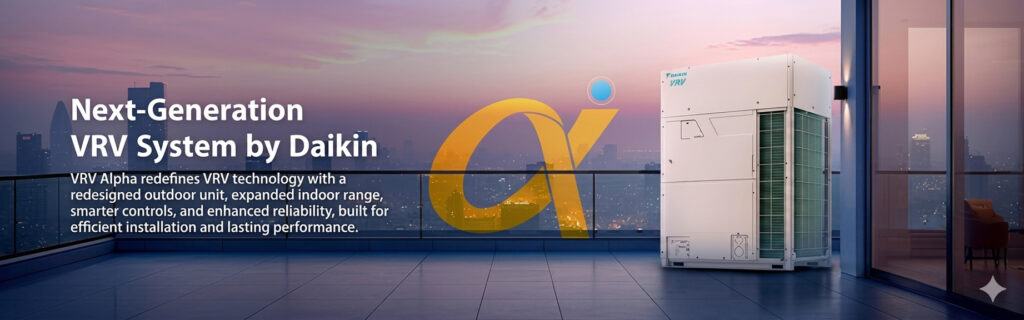
This means that the HVAC specification is not just an engineering decision on a green building project. It is a certification strategy decision. A poorly specified HVAC system can cost a building multiple rating points under any of the three systems. A well-specified, energy-efficient HVAC system — using inverter-driven VRV technology, BMS integration, demand-controlled ventilation, and proper load sizing — can be the difference between Silver and Gold, or between Gold and Platinum.
Specifically:
Under LEED: The Energy and Atmosphere category — optimising energy performance relative to ASHRAE 90.1 baseline — is almost entirely an HVAC and envelope exercise. VRV systems with high CoP, heat recovery, and BMS integration generate the energy credits that push buildings toward Gold or Platinum.
Under IGBC: Energy efficiency credits are weighted to Indian climatic conditions. Designs addressing Chennai's specific challenge — high ambient temperatures, high humidity, near-continuous cooling loads — receive credit for genuinely appropriate strategies.
Under GRIHA: Renewable energy credits are calculated as a percentage of HVAC, lighting, and domestic hot water consumption — meaning a lower-consuming HVAC system directly reduces the renewable energy required to hit credit thresholds.
The mistake most buildings make — and the window to avoid it
The most common and costly error in green building certification is treating it as a documentation exercise rather than a design strategy.
Buildings that approach certification late — after the HVAC system has already been specified, the floor plates locked, and the mechanical rooms sized — find themselves scrambling to hit points through expensive add-ons: rooftop solar panels sized for points rather than performance, water recycling systems retrofitted into a design not built to accommodate them, building controls added over a base building that was never designed for integration. It works. But it costs significantly more than it needed to.
⏰ The window for efficient certification is design stage. The buildings that achieve Gold and Platinum efficiently are the ones where the sustainability team, the MEP consultant, and the HVAC contractor are all in the room at the design development stage — before the structural grid is locked, before ceiling zones are committed, before the chiller room is dimensioned. Every month that passes after that makes the certification more expensive to achieve and the building less optimised for actual performance.
Our position — and what it means for your project
We do not certify buildings. That is the work of green building consultants, energy modellers, and the certification bodies themselves. What we do is engineer and install the HVAC systems that determine, more than any other single element, what certification level a building can achieve.
We have delivered HVAC across some of South India's most landmark commercial, residential, healthcare, and educational developments — buildings that have pursued LEED Gold, IGBC Platinum, and GRIHA star ratings. In each case, the approach was the same: engage the certification conversation at design stage, specify systems that are right for the building and the rating being targeted, and commission with the rigour that energy performance documentation demands.
If you are planning a commercial development in Chennai, Bangalore, or anywhere in South India and are navigating the certification question, the HVAC conversation should happen in the same meeting. They are not separate decisions. The system you install will define your energy performance credits, your IAQ credits, your operational cost profile, and ultimately your certification level for the life of the building.
Choose the rating that matches your tenants and your market. Then specify the HVAC that gets you there. We can help with the second part — and we can have the conversation at the right stage of your project to make it count.