
India's HVAC Market Is Set to Nearly Double by 2030.
What That Means for Every Building Owner Right Now.
The numbers are not projections from optimistic consultants. They come from multiple independent research firms — and they tell the same story. India's cooling infrastructure is entering the most consequential growth phase in its history. Here is what is driving it, what it means for the built environment in South India, and why the decisions made today will define energy costs and asset values for the next 25 years.
Let's start with a number that puts everything else in perspective: only 10% of Indian urban households currently own an air conditioner. In higher-income urban households, that number reaches 20–25%. In cities like Delhi, Mumbai, and Bengaluru, penetration is meaningfully higher — but still nowhere near saturation. This single statistic explains why virtually every research firm covering this market is projecting the same thing: the growth ahead is not incremental. It is structural.
For context, consider China. China's urban AC penetration jumped from just 5% in the mid-1990s to nearly 100% by 2008 — adding over 200 million air conditioners in roughly 15 years. India now sits at a similar inflection point. The difference is that India's built environment is more complex, its climate more diverse, and its commercial real estate sector more sophisticated than China's was at a comparable stage. The demand will be larger, more layered, and more demanding of technical expertise.
The five forces reshaping India's cooling landscape
There is rarely a single reason behind market-scale growth. In India's case, five distinct forces are converging simultaneously — and each reinforces the others.
+320M urban residents by 2047
536 heatwave days in 2024 alone
89M sq. ft. leased in 2024 — record high
ECBC mandatory for all commercial builds
The commercial real estate story — and South India's role in it
If there is one sector that is driving the premium end of India's HVAC demand growth, it is commercial real estate — and South India is leading it. South India commanded 41% of India's commercial real estate market share in 2025, anchored by Bengaluru's annual office absorption of approximately 22 million sq. ft. and Chennai's emergence as a data centre capital, attracting USD 1.8 billion in data centre investment in 2025 alone.
The Global Capability Centre story is central to this. India hosted more than 1,700 GCCs by December 2025, employing 1.6 million professionals and absorbing nearly 60 million sq. ft. of office space annually. These are not ordinary tenants. GCCs demand Grade A buildings with Grade A infrastructure — and HVAC sits at the top of that infrastructure stack. Enterprise clients from the US, Europe, and Japan do not accept downtime, temperature inconsistency, or poor indoor air quality. Their facility specifications are exacting. Their preferred contractors are specialists.
South India's commercial HVAC opportunity in numbers
- Bengaluru absorbs ~22 million sq. ft. of office space annually.
- Chennai secured USD 1.8 billion in data centre capital expenditure in 2025.
- Hyderabad hosts 400+ GCCs employing 300,000 professionals.
- Kochi and Coimbatore grew 18–20% in commercial real estate absorption as GCC demand spills into Tier-2 cities.
- Every square foot of this space requires engineered HVAC — and the specifications are rising, not falling, as enterprise tenants demand higher comfort standards, tighter energy targets, and green building certifications.
The residential inflection — why homes are the next big story
The commercial sector dominates headlines, but the residential market is where the volume growth will be most dramatic. Between 2025 and 2035, India is expected to add 130 to 150 million new room air conditioners — a number that is almost incomprehensible in its scale. Urban areas alone face a current shortage of 10 million housing units, with an additional 25 million units of affordable housing required by 2030 to accommodate urban population growth.
What this means for the premium residential segment — the segment that Shri Vignesh works in — is equally significant. As middle-class expectations rise and apartment sizes grow, the question is no longer whether a home will have air conditioning. The question is what kind. Split ACs that clutter walls, crowd terraces, and run electricity bills up are being reconsidered by homeowners who understand there is a better way. The VRV residential segment is growing precisely because of this shift in expectation.
"Once considered a luxury confined to urban elites, air conditioners have now become a necessity across Indian homes, offices, supermarkets, and commercial establishments. India now finds itself at the same inflection point China reached in the mid-1990s — just before penetration exploded." — Renub Research, 2025 India AC Market Report
What the growth timeline looks like
India HVAC market: $11.2 billion · Record office leasing of 89 million sq. ft. India experiences one of its hottest summers in 14 years — 536 heatwave days, 700+ heatstroke deaths. AC penetration in urban households: ~10%.
Market reaches $12.1 billion — ACREX 2026 forecasts 15% annual growth. Industry leaders at ACREX India 2026 confirm the sector is growing at nearly 15% annually and could double within five years. Daikin, LG, Carrier all announce India manufacturing expansions. GST on ACs cut from 28% to 18% — first demand impact expected in summer 2026.
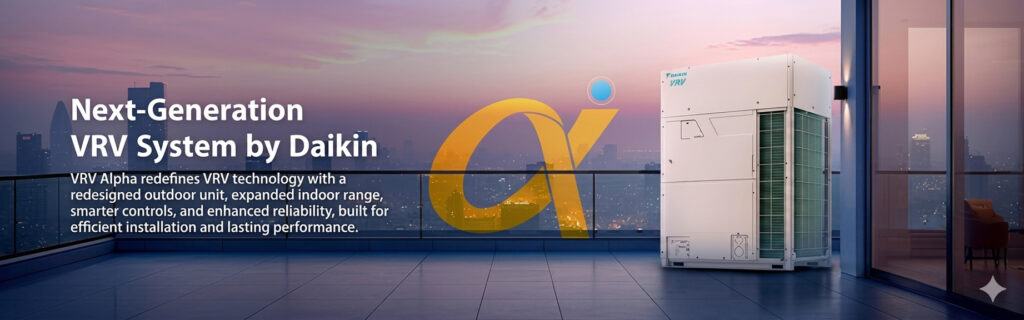
AI enters HVAC — Daikin launches VRV Alpha in India. The first AI-integrated VRV platform arrives in the Indian market. Energy Conservation Building Code compliance becomes a baseline expectation. BEE 2026 star rating standards tighten further, accelerating the market's shift to premium systems.
Market projected at $17–30 billion depending on research source. Urban population reaches 600 million. 30 million AC units sold annually (up from 15 million today). Total built-up commercial real estate supply in top 8 cities grows 42%. India's real estate sector's contribution to GDP rises from 7% to 15%.
$18.9–45 billion market — convergence of all growth vectors. Residential penetration in urban areas approaches 40–50%. Commercial HVAC retrofit cycle begins in earnest as systems installed in the 2010s reach end of efficient life. Energy efficiency mandates now encompass virtually all building types. Tier-2 cities emerge as major demand centres.
The retrofit wave that nobody is talking about enough
Lost in the conversation about new building HVAC demand is an equally significant opportunity: India's existing building stock. The commercial buildings constructed between 2005 and 2015 are now approaching or past their HVAC systems' peak efficiency years. Chiller plants, AHUs, and early-generation VRF systems installed in that decade were designed for energy standards that are now well below current ECBC and BEE requirements.
The retrofit cycle is where long-term HVAC relationships are built. A building owner who installs a new chiller plant today is likely to work with the same contractor for AMC, system upgrades, and eventual full replacement over the next 15–20 years. This is not just market growth — it is the kind of sustained, relationship-driven revenue that defines the best HVAC companies over decades.
What this means for you as a building owner, developer, or facility manager in South India
The market growth numbers tell you the direction of travel. But the more useful question is: what should you actually do differently today?
First — specify for the building's full life, not just handover day. A system that costs 20% less to install but consumes 35% more energy over 15 years is not a saving. The total cost of ownership calculation has only one correct answer in today's energy price environment: specify higher. VRV and modern chiller plants with AI controls will pay back their premium within 3–5 years in operating cost savings alone.
Second — green building certification is becoming a commercial necessity, not a marketing exercise. Enterprise GCC tenants and multinational office occupiers are now routinely specifying green-certified buildings as a baseline requirement. Buildings without LEED, IGBC, or GRIHA certification will increasingly face lower occupancy and lower rents. HVAC accounts for 40–60% of a building's energy footprint — which means your HVAC choice is your green rating.
Third — if your system is more than 8 years old, start the retrofit conversation now. The energy degradation curve on aging HVAC equipment is steeper than most building owners realise. Waiting for failure is always more expensive than proactive planning — in downtime, emergency replacement costs, and the energy overbilling that happens silently for years before a system finally stops.
India's HVAC market is not simply growing. It is maturing — from an industry where the dominant question was "should we have air conditioning?" to one where the question is "what kind, at what efficiency, integrated with what?" That is a more sophisticated question, and it deserves a more sophisticated answer. We have been providing that answer across South India for over 15 years. We are ready for what comes next.
Key facts from this article — verified sources
India HVAC market 2025–2030
Mordor Intelligence (conservative estimate). Other projections from P&S Intelligence and IMARC Group reach $29–45B by 2030–2033 depending on methodology.
Urban household AC penetration
ScienceDirect / NSS 2024 survey. Rising to 20–25% in higher-income groups. Delhi, Mumbai, Bengaluru significantly higher. National average still far from saturation.
India office leasing in 2024
JLL / Cushman & Wakefield. Highest year on record. 19% jump over 2023. Q1 2026 recorded the highest-ever single quarter — 29.9 million sq. ft.
South India's commercial real estate share
Mordor Intelligence Commercial Real Estate Report 2025. Bengaluru alone accounts for ~22M sq. ft. of annual office absorption.
Planning a new build or reviewing an existing system?
The market is moving toward higher efficiency, smarter systems, and green-certified infrastructure. We help building owners in South India specify, install, and maintain HVAC systems that stay ahead of that curve — not behind it.